


Any progress on measuring and disclosing private capital mobilisation? An MDB scorecard
Private capital mobilisation (PCM) has become central to the case multilateral development banks (MDBs) make about their development impact. So the way it is measured and disclosed matters more than ever. Narrow methodologies can miss important forms of mobilisation, while weak disclosure leaves headline numbers difficult to interpret or test. Better calculation and better disclosure are therefore essential to understanding whether MDBs are genuinely mobilising new private investment, through which mechanisms, and at what scale.
In the October 2024 report What Works: How to measure and disclose private capital mobilisation to increase private investment and close the SDG financing gap Publish What You Fund proposed a series of improvements to the measurement and disclosure of PCM data. The report recommended expanding the scope of PCM measurement to capture additional leveraging mechanisms that MDBs and development finance institutions (DFIs) deploy, while also recommending that institutions disclose granular project-level data including details regarding geography, leveraging mechanism, and a typology of mobilised parties.
To date, we have seen some signs of adoption of these recommendations, particularly through the Organisation for Economic Cooperation and Development (OECD) approach to measuring PCM. The OECD is currently trialling data collection for “balance-sheet optimisation” (attracting capital to the institution’s balance sheet through bond issuances, equity, and hybrid capital sales) and “portfolio mobilisation” that includes exits and risk transfers. We understand that the MDB Task Force on Mobilization is reviewing the MDB approach to measuring PCM, although there has been no public disclosure of progress to date.
In advance of the forthcoming Mobilization of Private Finance by Multilateral Development Banks and Development Finance Institutions 2024 Joint Report, that is expected to be published in time for the World Bank Spring Meetings, Publish What You Fund has developed a scorecard that we’ll use to assess progress against the What Works recommendations. The scorecard is split into six criteria across two themes; PCM measurement, and PCM disclosure.
Measurement
- Balance Sheet Mobilisation – Does the MDB approach to measuring PCM include a methodology for measuring mobilisation through attracting private capital to the balance sheet of the institution through instruments such as bond issuances, equity, and hybrid capital sales?
- Secondary mobilisation – Does the MDB approach to measuring PCM include a methodology for measuring mobilisation where risk is moved off institution’s balance sheets through exits, securitisations and other similar instruments?
- Catalysation – Does the MDB approach to measuring mobilisation include a methodology for measuring private capital catalysation?
Disclosure
- Further disaggregation – Can we see each institution’s performance? – Does the MDB Joint Report include further disaggregated data including total mobilisation by sector for each institution and total mobilisation by instrument for each institution?
- Investment data – Can we see the detail behind the headlines? – Does the MDB Joint Report include a dataset that discloses total private mobilisation, private direct mobilisation, and private indirect mobilisation per ?
- Full project level disclosure – Can we see the type of mobilised organisation and how they are mobilised? – Does the MDB Joint Report include a dataset that discloses PCM in line with the recommendations set out in What Works, including data fields covering investment, investment value, total amount mobilised, geography, investment instrument, sector, disaggregated amounts mobilised, mobilised party typology?
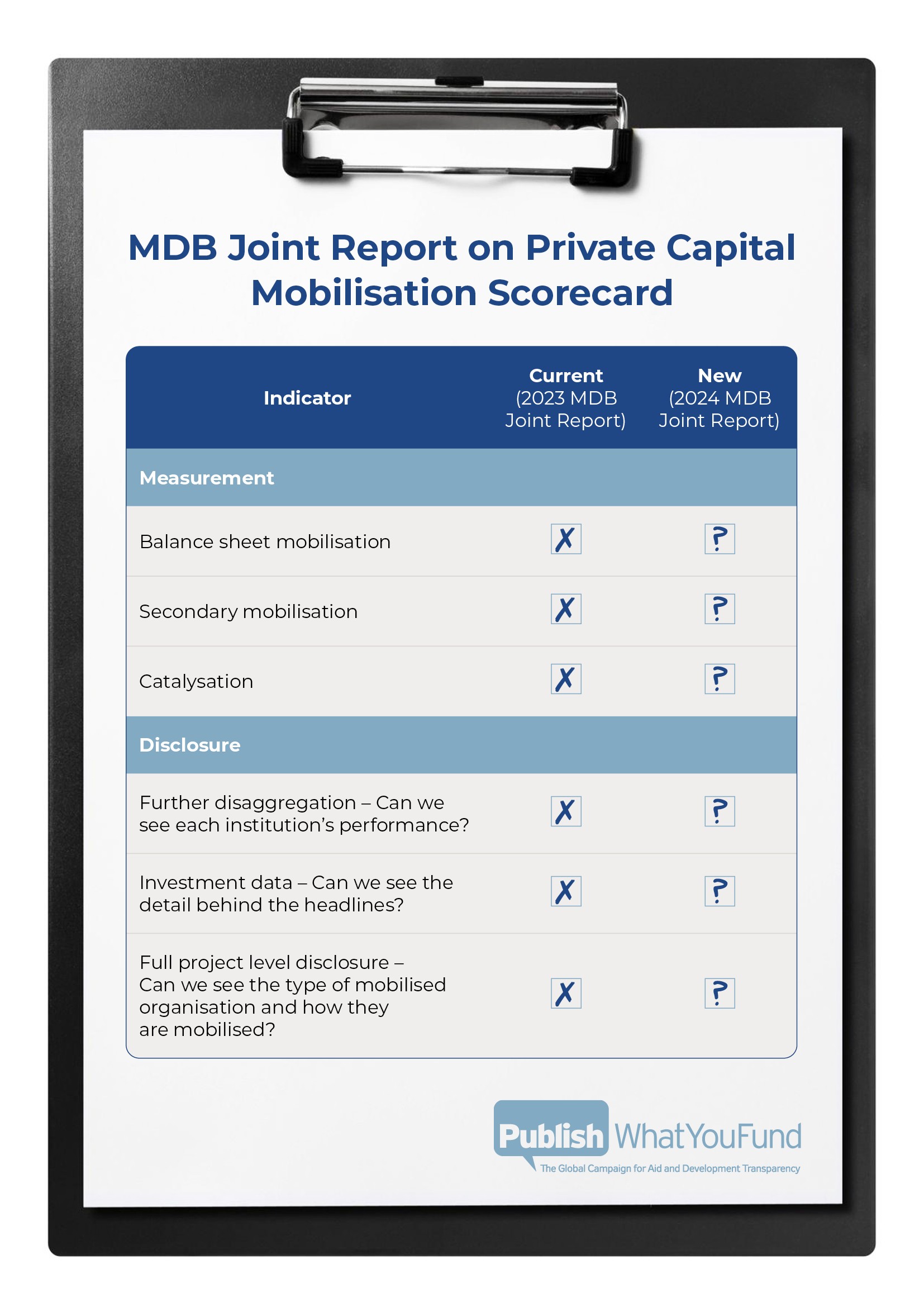
Once the MDB Task Force on Mobilization publishes the joint report for 2024, we’ll revisit the scorecard. We will assess the new report against the six indicators and publish an updated scorecard. We hope to see progress across both measurement and disclosure, and continue to push for improvements in PCM data. Keep an eye out for the completed scorecard in the coming weeks.