


Hype vs evidence: What do we really know about the building blocks of the future development finance landscape?
There’s something that’s been bothering me for a while now. And I keep wondering whether it’s bothering anyone else, or whether it should be. Because it feels like an important discussion that we’re somehow not really having.
Spend any time in the big global conversations about the future of development and international cooperation (think FFD4, Davos, Munich Security Conference) and you’ll hear lots of thoughtful, ambitious ideas. There is important work under way on development effectiveness, on how the aid and development finance system needs to evolve, where real power should reside, and on what kinds of institutions and instruments might play a bigger role in the years ahead. You hear about blended finance, guarantees, results-based financing, private capital mobilisation, impact investing, national development banks and philanthropies. You hear about the need to crowd in private investment and do more with less.
All of that is necessary. Much of it is exciting. Some of it may well be essential if we’re going to shift power and establish a system to meet the scale of today’s challenges.
But as someone who has spent many years working on transparency and data in this sector, I find myself asking a slightly awkward question: how well do we really understand the impact of each of these approaches?
Because when you look closely at the data underpinning each of these building blocks and the instruments they deploy, the reality is that in many cases the data is missing and the evidence of impact is weak or non-existent.
Different types of organisations disclose very different levels of information about their costs and impact
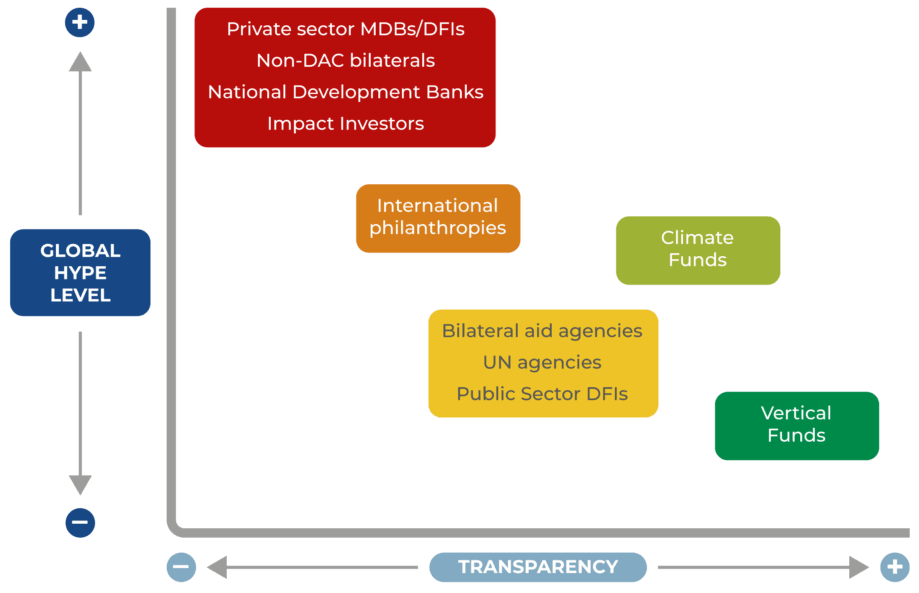
If you step back and look across the development finance landscape, different types of organisations disclose very different levels of information about what they spend, what they do, and what results they achieve. Some publish reasonably comprehensive, project-level information on costs and outcomes. Others publish very little that would allow an external observer to understand what happened on a specific investment or programme, what it cost, and what it achieved.
“If we’re rebuilding the system, it seems reasonable to want to know how well the pieces actually work.”
And here’s the slightly uncomfortable bit. Many of the institutions and instruments that feature most prominently in current debates about the future of development finance (think private finance, private capital mobilisation, blended finance) also happen to be those where project-level cost and impact information is often weakest.
That’s not true in every case. Within each organisational category, whether we’re talking about development finance institutions, philanthropies, climate funds or bilateral agencies, there’s a spectrum. There are leaders that disclose more, and there are others that disclose less. But when you group these actors together as if they are interchangeable building blocks of a future system, the differences start to matter.
Over the past decade and more, we’ve looked at transparency across a wide range of organisation types through the Aid Transparency Index, the DFI Transparency Index and a series of thematic studies. Pulling those findings together, a consistent pattern emerges. Some parts of the system routinely publish granular financial and results information at project level. Others tend to rely on high-level summaries, portfolio-wide reporting or selective case studies. In some cases, there is almost no publicly available information that would allow you to assess impact, cost-effectiveness or return on investment at the level of an individual intervention.
Governments of all kinds need detailed cost and impact information to compare approaches and allocate resources
None of this means that these organisations or instruments are ineffective. It doesn’t mean they don’t deliver impact. And it’s important to say that project-level disclosure is not the only way to understand results. There are excellent sector-wide evaluations, thematic reviews and independent research that tell us a great deal about what works and what doesn’t.
But project-level information does something very specific and very valuable. Without that level of detail, it becomes much harder to compare approaches, learn systematically or allocate scarce resources with confidence.
Another dimension in this discussion is the role of recipient governments. Partner country governments are expected to set priorities, coordinate domestic and external resources, and hold providers to account through their own plans and systems.
Yet if my analysis is correct, that task is becoming more complex. As finance flows through a growing range of institutions and instruments, and information remains partial or inconsistent, it becomes difficult for governments to see who is financing what, on what terms, and with what results. Without comparable, project-level information on costs and outcomes, they cannot easily compare approaches, identify gaps or duplication, or allocate resources with confidence.
Weak transparency is therefore not only a problem for external observers. It constrains country-led planning and coordination, and risks shifting decision-making away from the institutions meant to lead development. As the system grows more complex, enabling governments to see and understand the full picture should be a central objective of transparency efforts.
The strength of the narrative is not matched by the strength of the evidence
Which brings me back to the question that’s been nagging at me. Why is it that so much of the optimism and policy rhetoric (frankly speaking: hype) about the future of development finance seems to be concentrated around precisely those areas where the underlying project-level evidence is often hardest to see?
Is it simply that these approaches are newer, more complex and therefore harder to measure? Possibly. Is it that there are legitimate commercial or political sensitivities that make disclosure more difficult? In some cases, maybe. Are there strong incentives for governments and institutions to favour certain models, particularly those that promise to mobilise private capital or stretch limited public resources further? Almost certainly.
But it’s still worth asking whether the strength of the narrative is always matched by the strength of the publicly available evidence.
Making informed choices about the future development finance architecture
As a sector, we often say that we want to allocate resources to the approaches that deliver the greatest impact at the lowest cost. If that’s the case, then comparable information on costs and results isn’t a luxury. It’s a prerequisite for making informed choices. And if the future development finance architecture is being constructed from a diverse set of organisational models and financial instruments, then it matters whether those building blocks operate on a level playing field when it comes to transparency.
“We should be asking whether we have enough information to back up some of our strongest assumptions about the future of development finance.”
This isn’t an argument for a single model of reporting or for every organisation to look the same. Different mandates and instruments require different approaches. Nor is it an argument against innovation or against any particular type of institution.
It’s simply a plea for a more open conversation. If we are serious about effectiveness, impact and value for money, then we need to pay attention not only to what we hope different actors and instruments can achieve, but also to what we can actually see about their performance. At the very least, we should be asking whether we have enough information to back up some of our strongest assumptions about the future of development finance. Ultimately, improving visibility across development finance is not just about better global analysis. It is about ensuring that governments themselves can see, compare and manage the resources intended to support their own development.
If we’re rebuilding the system, it seems reasonable to want to know how well the pieces actually work.