

News roundup – UN transparency, hype vs evidence, funding to end child marriage and DFI disclosure examples
Welcome to the latest roundup of news from the world of aid and development transparency.
UN transparency and the global data landscape
As aid budgets tighten and scrutiny increases, the ability to clearly demonstrate impact, value for money and results is critical for the UN system.
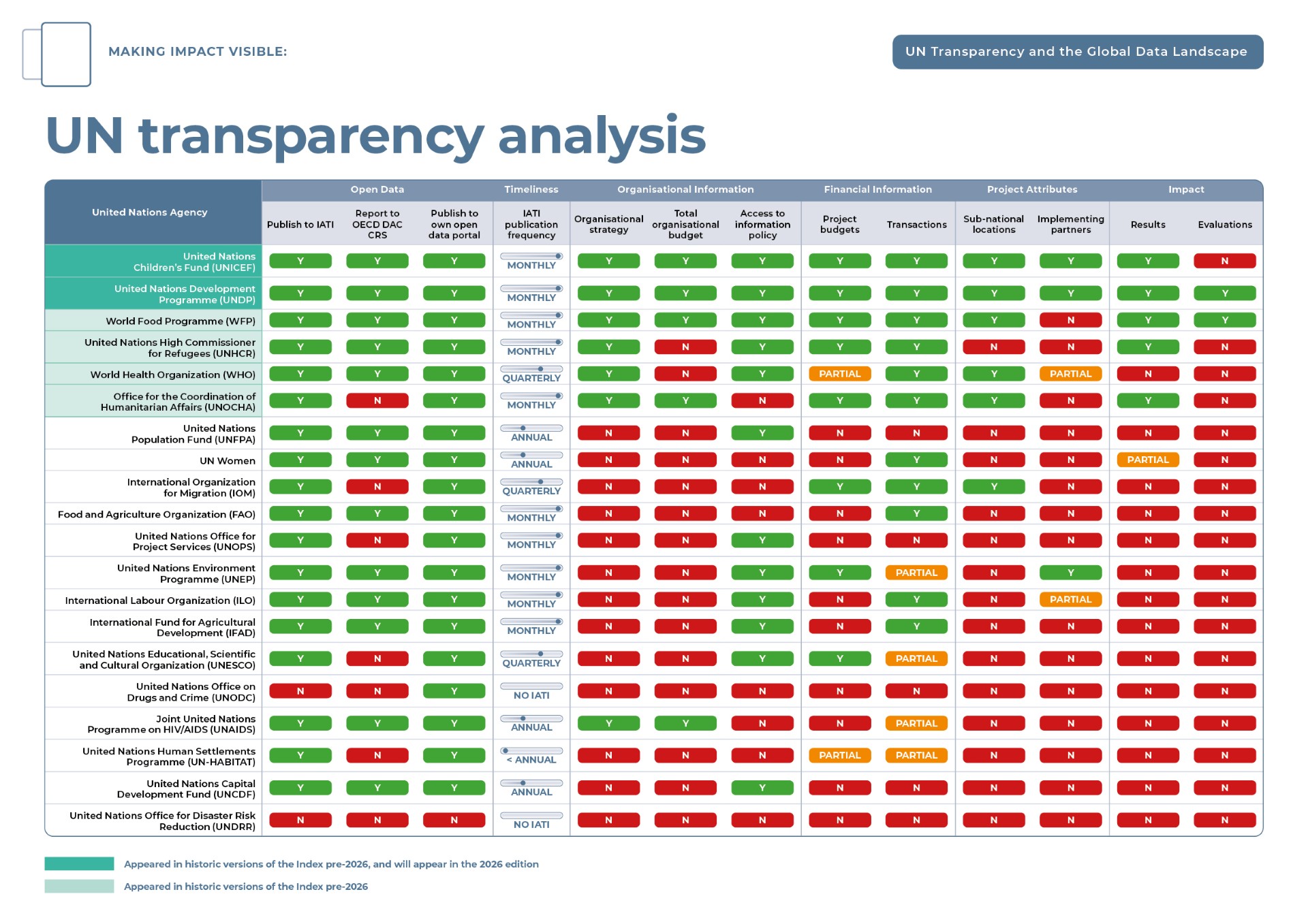
Our new report Making Impact Visible – UN Transparency and the Global Data Landscape, examines transparency practices across 20 UN agencies. Key findings include:
- 18 agencies now publish to the International Aid Transparency Initiative (IATI) Standard – an important step toward open and comparable data
- However, inconsistent and incomplete reporting limits the usefulness of this information
- Sharing more timely and forward-looking data to IATI would help strengthen alignment with other development and humanitarian spending
- UN agencies that have participated in the Aid Transparency Index consistently perform better on transparency compared to other UN agencies
The report argues that publishing more detailed information on programmes, partners, locations and results will help make UN impact more visible – supporting coordination, accountability and learning across the global development community. The UN80 reform process offers a timely opportunity to strengthen transparency practices across the UN system.
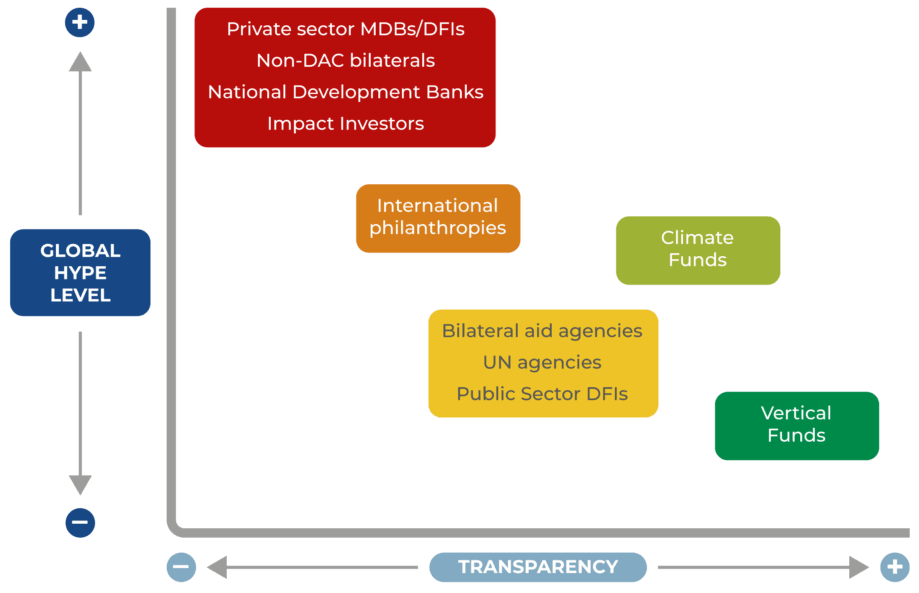
This is the first in a four-part series of reviews examining the transparency practices of some of the groups that don’t feature in the Aid Transparency Index. Look out for our forthcoming reports on philanthropies, private sector contractors, and non-traditional donors.
Hype vs evidence: What do we really know about the building blocks of the future development finance landscape?
Blended finance, guarantees, private capital mobilisation, impact investing, national development banks, and philanthropies are just some of the approaches being considered as key elements of the future development finance system. But what do we know about their value and impact? Does the evidence support the hype?
In this blog, Gary Forster asks how well we really understand the impact of the myriad development finance approaches. He sets out why, as traditional aid budgets shrink, we need comparable information about the approaches that many hope will fill the gaps.
Analysing international funding to end child marriage
We are proud to have partnered with Girls Not Brides and Girls First Fund on their new report – International Funding to End Child Marriage: Reviewing a Decade of Investment. We carried out analysis of funding to end child marriage over the last decade, focusing on major bilateral, multilateral and philanthropic donors. Our innovative analysis used three data sources: IATI, OECD DAC CRS, and Candid. We were able to use the rich detail in the data to analyse types of objectives, funding sectors, recipient countries and implementing partner types.
Updated Disclosure Example Book shows DFIs what is possible
We have just published an updated edition of our Disclosure Example Book, a practical resource designed to support development finance institutions (DFIs) in improving the transparency of their disclosures. The book brings together examples of how a wide range of project- and organisation-level information is currently disclosed across the DFI sector, demonstrating what is possible in practice.
The book was first released in 2023, in response to demand from DFIs for real-life examples of how and where their peers publish information. It is designed to address perceived barriers and guide improved disclosure. We hope it will remain a useful resource for anyone working to strengthen DFI transparency.
Download the Disclosure Example Book
Proposed changes to the 2027 DFI Transparency Index methodology
Following an in-depth internal review of the DFI Transparency Index, we’ve published proposed changes to the methodology for the 2027 edition. Our goal is to strengthen the rigour of the Index while maintaining comparability across the 2023, 2025 and 2027 editions. We welcome feedback from across the community by 20 April.
Join our training: An introduction to using international aid and development data
Learn how to find and explore data to answer your aid and development questions with our one-hour training session. It’s free and interactive. Sign up today to gain valuable insights to assist your research, planning, fundraising, advocacy or campaigning work.
Over the course of one hour we’ll introduce you to the leading global open aid dataset – the International Aid Transparency Initiative – and how to access and navigate information on over a million development, humanitarian and climate projects. In 2025, over 200 people from 48 countries joined our training sessions.
Next dates:
📅 Monday 20 April, 11am BST
📅 Wednesday 20 May, 5pm BST
Other news
Here’s a quick roundup of other news and publications we’ve been reading over the last few weeks:
A report from the World Resources Institute examines the open governance issues of transparency, participation and accountability in the climate finance system. It finds that while information on climate finance has increased, limitations remain. Without increased transparency, the public can only access a partial picture of where climate finance comes from and where it is flowing. The report says that multilateral funders have relatively consistent approaches to transparency, participation, and accountability, but bilateral funders’ policies vary considerably. Governance of private climate finance remains the least transparent, participatory, or accountable. The report also highlights the need for a common definition for climate finance, strengthening accountability mechanisms and establishing more robust enforcement frameworks.
Our US-based partner organisation, Friends of Publish What You Fund, has launched a new website and refreshed its focus on improving the transparency, effectiveness and accountability of US foreign assistance.
IATI has published the State of the Data Review 2025, bringing together six months of analysis on the publication, quality and usability of IATI data. The dataset now contains half a million linked documents providing context to development activities and data on more than 17,000 organisations across delivery chains. The review identifies practical steps to strengthen the accessibility, quality and long-term usefulness of IATI data.
This blog from Center for Global Development looks at the low levels of transparency on blended concessional finance, particularly the lack of recent reports from the DFI Working Group. The author argues that donors should require better disclosure before they provide further concessional finance.
Donor Tracker has examined development guarantees – tipped as one of the most catalytic instruments in the blended finance toolbox. The new publication looks at how guarantees work, who the major providers are, and what challenges remain – including transparency gaps.
A new UN Trade and Development (UNCTAD) report warns that much of the reported rise in climate finance may not represent new funding for lower-income countries. The analysis points to the growing role of accounting practices in shaping reported climate finance figures. The report calls for stronger transparency, clearer definitions and common accounting standards to prevent double-counting and improve comparability across providers. It also urges richer countries to meet both their ODA commitments and climate finance targets.
The OECD has published the 2025 Development Assistance Committee (DAC) peer review of the EU’s development cooperation. CONCORD has reacted to the review, highlighting concerns over transparency. It says there is limited public information on Global Gateway project selection, investment volumes and results, making it difficult to track whether funding delivers on development goals. It also points out that it is hard to track how much ODA is allocated through the Global Gateway.
Spotlight on Corruption has launched the Clean and Green Manifesto which focuses on how the UK’s anti-corruption efforts can help tackle environmental harm. Backed by a group of 30 civil society organisations, the manifesto’s recommendations include actions to make climate finance more transparent and fair and to promote accountability for corrupt actors who harm the environment. Publish What You Fund was pleased to contribute to the transparency elements of the manifesto.
Campaign for Nature and Conservation International has launched a Nature Finance Tracker using data obtained through Freedom of Information requests covering 2021-2025. It provides the first comprehensive public analysis of UK international nature finance spending, and makes those commitments visible, understandable, and accountable.
The United Nations Development Programme (UNDP) Seoul Policy Centre has published research into IATI’s role as a decision-support system for UN agencies and development practitioners. It provides an assessment of IATI’s current capabilities and limitations in supporting data-based decision-making and offers solutions to enhance this role. It concludes that success requires coordinated effort across the IATI ecosystem, emphasising strengthened data standards, enhanced user capacity, and fostered innovation in data applications.
The Centre for Law and Democracy (CLD) has launched a new website, making it easier to search for CLD work, online courses and news releases.
Sign up to receive our newsletter direct to your inbox.