
UN Transparency

The United Nations (UN) system has played a central role in shaping global norms on transparency in development and humanitarian cooperation. Over the past two decades, the UN system has contributed to international agreements that positioned transparency as fundamental to accountability, coordination, and development effectiveness, including the Accra Agenda for Action and the Busan Partnership for Effective Development Cooperation. More recently, through the Financing for Development process, including the Fourth International Conference on Financing for Development, the UN System has continued to promote transparency as an enabler of sustainable financing and trust in multilateral institutions.
Transparency across UN agencies is critical given the scale of resources they manage and the complex contexts in which they operate. In 2024 alone, the UN system collectively managed revenues of over US$68 billion, with UN programmes in 162 countries. Transparent, accessible, and timely information enables Member States, donors, and partners to assess performance, manage risk, and coordinate more effectively. It also supports partner governments, civil society, and affected communities to engage with and scrutinise UN-supported activities.
This importance is heightened amid ongoing financing constraints and growing pressure on UN agencies to demonstrate value for money. In this context, there is an opportunity for transparency to be used as a pillar of development effectiveness, constructive coordination, and to emphasise the credibility of the UN system.
Making Impact Visible: UN Transparency and the Global Data Landscape
In March 2026, Publish What You Fund launched a new brief, which reviews the transparency practices of 20 of the largest operational UN agencies. It focuses on how consistently and effectively they publish financial and programme information in the International Aid Transparency Initiative (IATI) Standard. This global standard enables comparability with other development and humanitarian finance. The analysis is intended as a diagnostic exercise, highlighting areas of relative strength and identifying where transparency practices could be improved to better support accountability, coordination, and development effectiveness.
Our findings
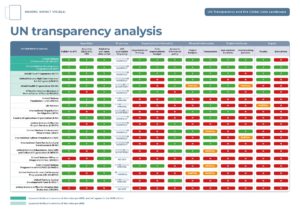
The review, Making Impact Visible: UN Transparency and the Global Data Landscape, finds that transparency infrastructure across the UN system is now largely established. 18 of the 20 agencies publish data in the IATI Standard, a majority report to the Organisation for Economic Cooperation and Development-Development Assistance Committee (OECD DAC) Creditor Reporting System, and most operate their own open data portals. This reflects broad alignment with international transparency norms and represents a significant portion of data on UN activities and financing.
However, the usefulness of this information is limited by inconsistent and incomplete data. Key findings from the review include:
- Less than half of the agencies reviewed publish IATI data on a regular monthly basis, limiting the usefulness of information for real-time coordination and oversight.
- Organisational transparency is particularly weak: only a small number of agencies publish current organisation strategies or forward-looking budgets.
- While financial transaction data is more widely available, project-level budgets are often highly aggregated and rarely extend beyond short time horizons.
- Most gaps found in the data relate to delivery chains and impact: Few agencies disclose sub-national locations or implementing partners, constraining visibility over where and with whom programmes are delivered. Results and evaluation data is scarce, with only a handful of agencies publishing regular results information, making it difficult to link funding to outcomes or assess effectiveness at scale.
- There are clear transparency differences between the agencies that have previously been assessed through the Aid Transparency Index and those that have not.
Our conclusion and recommendations
This review comes at a time of heightened external scrutiny and financial uncertainty. In this environment, transparent disclosure of resources and activities is essential to protect trust, show value for money, and demonstrate impact. This challenge is becoming more acute as policy analysis and decision-making are increasingly shaped by AI-enabled tools that rely on structured, machine-readable information. Work that is not visible in data risks being overlooked altogether.
The UN system now has a critical opportunity to re-affirm and strengthen its commitment to transparency. The UN80 reform process provides a timely platform to coordinate disclosure practices across agencies. A more structured, system-wide approach could reduce duplication, foster shared learning, and accelerate measurable improvements in transparency.
The review also makes specific recommendations for UN agencies:
- Strengthen forward-looking organisation and project-level disclosure
- Systematise the publication of results and evaluation information to IATI
- Increase transparency of delivery chains to support localisation and accountability
DOWNLOAD THE REPORT
DOWNLOAD THE EXECUTIVE SUMMARY
Our Making Impact Visible series
This is the first in a series of four ‘Making Impact Visible’ reports that we will release over the next year.
Every two years, Publish What You Fund produces the Aid Transparency Index, which assesses the world’s leading aid and development finance organisations and provides a detailed and granular analysis of their transparency. However, the universe of organisations involved in delivering aid and development is far broader than those that can be included within the Index itself. This series, therefore, provides an opportunity to examine transparency across four important groups of actors in the aid and development delivery chain:
- UN agencies
- Major philanthropies
- Private aid contractors
- Non-traditional donors
Together, these reports will offer a consistent and comparable assessment of the quality, comprehensiveness, and timeliness of the information these organisations publish, helping stakeholders understand how visible their activities and impact are within the global development data landscape.