

News roundup – Lessons learned from tracking local funding and our private capital mobilisation scorecard for multilateral development banks
Welcome to the latest roundup of news from the world of aid and development transparency.
Three key lessons for improving how local funding is tracked and understood
Over the last five years we’ve produced five research reports spotlighting international funding directed to local organisations. We’ve attempted to track funding from major donors and assessed how donors and philanthropies report local funding streams. Our team has examined thousands of data points, tackled methodological challenges and addressed definition dilemmas. As discussions continue on re-prioritising locally led development, we wanted to share some of the lessons we’ve learned on the challenges of tracking local funding and the barriers that still limit our understanding of how much funding is actually reaching local groups.
Three lessons stand out:
- Clear and transparent definitions of “local” are essential – without them, reported figures lack credibility.
- Consistent and well-explained measurement approaches are needed to ensure results are meaningful and comparable.
- Data gaps remain a major constraint, with most donors not publishing the detailed, accessible information required for effective tracking.
Our research has highlighted that commitments to localisation are not matched by the ability to measure and demonstrate progress.
Is the MDB Joint Report on private capital mobilisation sliding into irrelevance?
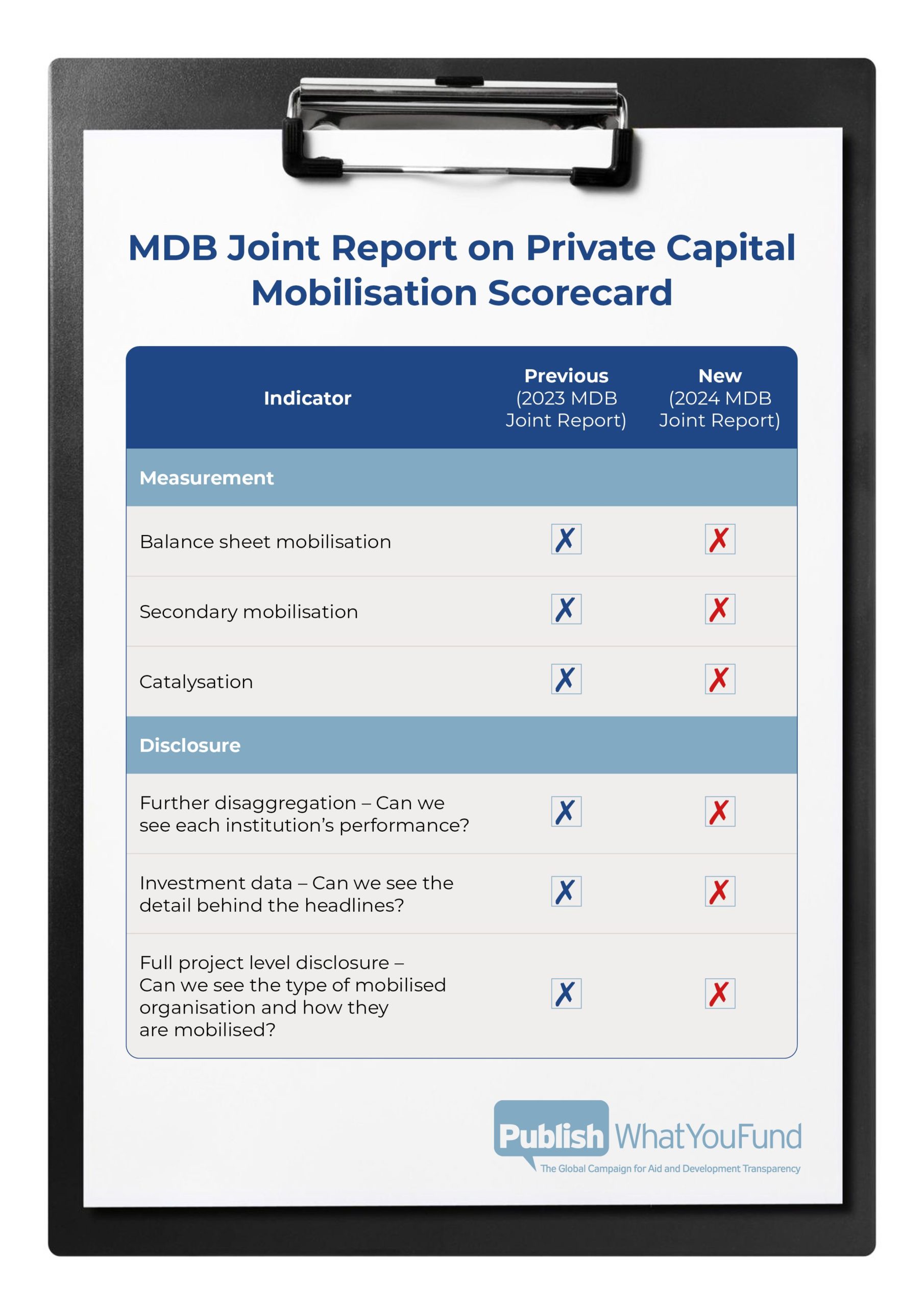
To maximise the efficiency and effectiveness of mobilisation efforts, it’s clear that improvements are needed in the way private capital mobilisation (PCM) is measured and disclosed. Following much research and consultation, we highlighted the improvements needed in our What Works report. We recently distilled these into a new scorecard to assess the progress of the latest MDB Joint Report.
The long-awaited report, capturing the mobilisation achieved by multilateral development banks and development finance institutions in 2024, is finally out. So how have they done?
Paul James has examined the latest trends and the progress made in a new blog. While the headline figures may be encouraging, he found:
❌ No demonstrable progress on reforming PCM measurement
❌ No meaningful improvement in transparency of PCM data
The Joint Report offers little in terms of new insight into how private capital is mobilised. If private capital is one of the answers to the development financing gap, we need to know more.
UK government responds to aid transparency review
The 2025 UK Aid Transparency Review, led by Publish What You Fund and commissioned by the UK government, evaluated the transparency of Official Development Assistance (ODA) spending by government departments beyond the Foreign, Commonwealth and Development Office (FCDO). The UK government has now published details of how it will respond to the review, including actions departments will take to improve openness and accountability for aid spending.
Publish What You Fund welcomes the response. We are encouraged to see a number of our recommendations to aid spending departments accepted, and we look forward to working constructively with government and partners to support implementation. Where challenges remain, we hope to continue an open and evidence-based dialogue on how the UK can further strengthen the transparency, quality and usability of its aid and development finance data.
Read more about the review here
New web dashboard for MDB climate finance data
Earlier this year we launched our MDB climate finance dataset – the first cross-MDB repository compiling all publicly available, project-level climate finance data disclosed by multilateral development banks (MDBs) between 2021 and 2024. We’ve now released the dataset as a web-based dashboard, to allow for easy filtering by institution, country, year and project type.
Join our training: An introduction to using international aid and development data
Learn how to find and explore data to answer your aid and development questions with our one-hour training session. It’s free and interactive. Sign up today to gain valuable insights to assist your research, planning, fundraising, advocacy or campaigning work.
Over the course of one hour we’ll introduce you to the leading global open aid dataset – the International Aid Transparency Initiative (IATI) – and how to access and navigate information on over a million development, humanitarian and climate projects. In 2025, over 200 people from 48 countries joined our training sessions.
Final date before the summer break:
📅 Monday 20 July, 3pm BST
Other news
Here’s a quick roundup of other news and publications we’ve been reading over the last few weeks:
The Organisation for Economic Co-operation and Development’s (OECD’s) preliminary 2025 ODA data shows an historic decline in aid. ODA by Development Assistance Committee (DAC) members and associates amounted to US$ 174.3 billion in 2025, a 23.1% decrease over 2024. It is the largest annual contraction on record and a second consecutive year of decline. The five largest DAC providers, Germany, the US, the UK, Japan and France, accounted for 95.7% of the total decline in ODA. The US alone drove three-quarters of the decline, with its ODA falling by 56.9% compared to 2024. This is the largest reduction in volume by any provider in any year on record. In 2025, Germany was the largest DAC provider of ODA for the first time in history, with its ODA totalling US$ 29.1 billion. The cuts hit bilateral aid and UN funding hardest and projections suggest a further 5.8% drop in DAC ODA in 2026, not yet accounting for additional strain from the current crisis in the Middle East.
The UN’s 2026 Financing for Sustainable Development Report: Implementing the Sevilla Commitment report finds that, with only four years to go until the delivery date of the 2030 Agenda for Sustainable Development, the world is rapidly moving backwards on global development. The report identifies a dangerous combination of global fragmentation and an acute financing squeeze facing poor and vulnerable countries as the primary drivers of this regression. However, it also explains how the Sevilla Commitment can be operationalised to reverse the current trends in financing for development.
A Center for Global Development (CGD) note – developed following a year-long consultation with development officials and independent experts – sets out a clearer case for aid, focused on ODA. One of its key messages is that public support for aid depends on humility and transparency – at home and abroad. It concludes that in an era of fiscal pressure, the purpose of investing public money abroad must be clear, and how it is deployed must be more disciplined.
UN OCHA’s Centre for Humanitarian Data has published The State of Open Humanitarian Data 2026, which shows that despite a tumultuous year, there was only a marginal decrease in data availability across crises. The report estimates that 68 percent of crisis data is available and up to date across 22 humanitarian operations, down from 74 percent in the previous year. The report provides details on the data available for each location, category and sub-category covered in the Humanitarian Data Exchange (HDX) data grids. It also includes an overview of the impact of AI bots on web traffic and open data platforms with the aggressive rollout of large language models.
Open Contracting Partnership has published research into the development of a digital delivery platform to track and manage climate finance. It focuses on the needs and goals of the human users who want better data and information about what happens in countries and communities at the investment project level.
A report from the Institute for Journalism and Social Change and Noor reveals how philanthropic funding linked to major tech players has supported anti-rights groups worldwide. It finds that seven internationally active US anti-rights groups, opposing sexual and reproductive rights around the world, received at least US$3.6 million from the Silicon Valley Community Foundation (SVCF) over the decade from fiscal year 2014 to 2023. At the same time, the SVCF has also channelled funding to groups that promote human rights, including sexual and reproductive rights. The report explores the impact of the funding and calls for greater transparency and accountability.
A study by Susanne Becken of Griffith University Australia published in the Climate and Development journal examines the role of development aid in achieving transformational climate action that integrates adaptation, mitigation, and inclusive development. The study focuses on how tourism-related aid engages with climate change and whether it holds transformational potential. Drawing on IATI data, the research analyses 842 tourism projects, with a total value of US$13.13 billion, and found only 89 of these projects explicitly address climate change. Further examination of the 89 projects finds that adaptation dominates, often focused on building disaster resilience, while mitigation is largely confined to forest carbon sinks, with limited decarbonising investment. Most projects remain incremental. The paper argues that deliberate design choices are needed in both bilateral and multilateral funding to advance tourism’s contribution to climate-resilient, low carbon, and just development.
A new study aims to assess the impact of reductions in ODA from 11 major donor European countries on mortality in 130 low- and middle-income countries (LMICs) through 2030. The researchers, from Universities of Geneva, Barcelona and Masaryk, Public Health England, ONE Data, Centro de Investigação em Saúde da Manhiça (CISM), Government of Mozambique and others, conducted a modelling study using country-level data on ODA disbursements and published estimates of the association between ODA and mortality, and estimated changes in averted deaths in different scenarios. The study finds that reductions in ODA from European donors may translate into millions of avoidable deaths in LMICs by 2030, even if funding stabilises over the coming years. These findings underscore the importance of sustained humanitarian and development assistance and highlight the toll of abrupt funding cuts.
The Trust, Accountability, and Inclusion Collaborative used IATI data in its research for a scan of mineral governance funding. The paper looks at where resources are flowing, where gaps remain, and how funders and practitioners can better coordinate and act strategically. At a time when global demand for mining and minerals is rising rapidly and governance needs are increasing, the paper finds that funding is tightening.
In an opinion piece for Devex, George Ingram and Sally Paxton of Friends of Publish What You Fund, warn that major transformations in US foreign assistance are happening at the same time as a sharp decline in accessible, reliable information. They argue that this poses a growing risk to sound decision-making and accountability at precisely the moment when both are most needed. The lack of transparency makes it difficult to assess what is changing, where funds are flowing, and whether results are being delivered.
The Bretton Woods Project has published a new scorecard that assesses the World Bank’s reported climate finance from FY2025, giving an overall scorecard grade of C-. It scored three criteria:
- Grant-based finance remains low – Grade D
- Policy-based lending raises governance concerns – Grade C
- Transparency remains uneven – Grade C
This CGD blog looks at spending figures from the US Agency for International Development (USAID) in fiscal year 2025. It highlights a 23% drop in spending compared to the previous year and a 43% drop in commitments to future spending. CGD has also examined the latest announcements from the UK government on aid cuts and what this means for humanitarian, bilateral and multilateral spending going forward.
ODI Global’s Humanitarian Policy Group has published new research examining international humanitarian funding to local and national actors. Using Financial Tracking Service data, partnership data from UN agencies, and IFRC’s databank, it found that just below 10% of international humanitarian funding reached local and national actors, directly and indirectly, in 2024. This is far below the Grand Bargain target of 25%. Direct funding remained low at 3.8%. It also found that international actors seemed to de-prioritise local funding in 2024, as it shrank by more that year than the overall international humanitarian funding pot. It recommends that, for meaningful accountability, governments should mandate UN agencies to publish their data in an accessible manner, and INGOs should comprehensively publish timely and accessible data on the quantity and quality of funding they provide to local and national actors.
Donor Tracker has launched a Multilateral Funding Tracker which draws on OECD data, multilateral reporting, donor budgets, and expert analysis to provide the most comprehensive picture possible of multilateral funding today and in the future. The tracker covers funding provided by the 18 largest OECD DAC donor governments to 17 multilateral organisations.
Eye on Global Transparency reports that a major bank in the Philippines has successfully used a confidentiality agreement with the International Finance Corporation (IFC) to prevent the disclosure of a consultant’s recommendations of remedial actions regarding problems with 10 controversial coal-fired power plants. The article says this case indicates that transparency at the IFC is not solely determined by its access to information policy, but also by the strictures of secret confidentiality agreements.
This Accountability Research Center blog looks at openwashing in the age of AI and the potential of generative AI to help citizens use open budget data for government accountability. It also examines the dangers of incomplete data and budget opacity.
Transparency International – Lebanon has welcomed
the launch of the national aid dashboard by the Government of Lebanon as a positive step toward enhancing transparency, coordination, and public access to information on aid distribution. It also calls for a number of measures to enhance the platform’s effectiveness, support traceability and align with international standards, including IATI.
A new report from Bond highlights that only 14% of investments made by British International Investment (BII) – the UK’s development finance institution – are made in the world’s least developed countries, and 14% in fragile and conflict affected states. It also finds that BII has made investment commitments worth US$640 million into billionaire-owned companies – including luxury hotel chains, fossil fuel fertilizer and dual fuel power plants. The report also finds that 92% of committed investments made through intermediaries go to companies domiciled in the UK and other G7 countries, or offshore, and calls on DFIs such as BII to adopt a locally led approach.
An analysis by Andrei Martin Diamante examines the scale and distribution of OECD-funded development assistance, focused on activities involving Indigenous Peoples, from 2016 to 2024. A public dashboard is available, with further research to be published soon.
Sign up to receive our newsletter direct to your inbox.