


MDB securitisations: transparency must keep pace with financial innovation
At a time of constrained public spending, and mounting needs for development and climate finance, multilateral development banks (MDBs) are being asked to do more with the capital they have. One way in which they are meeting this challenge is to turn to securitisations to free up capital for investment, mobilise private capital, or a combination of both. Since 2018, over $7.6 billion has been securitised by MDBs, and the regularity of such transactions has increased. As this specialised financial instrument is deployed more often, it raises a series of questions regarding what we can see about the transactions and their implications for development finance. This blog unpacks the latest trends in MDB securitisations and highlights instances where improvements in transparency are important for the proper governance of the institutions involved.
What is a securitisation and why are MDBs using them?
A securitisation is a way for a bank to pass some of the risk on its loans to outside investors. The bank groups a set of loans together. It then packages the risk that some borrowers won’t repay into securities, which are financial products investors can buy. In return for taking on that risk, the investors receive regular payments.
Why would an MDB do this? For every loan it makes, a bank has to set aside capital in case the loan isn’t repaid. Passing some of that risk to investors frees up capital, so the bank can make more loans. Securitisation can also bring private investors into development finance.
There are two main ways to do it. In a “true-sale” securitisation, the bank sells the loans to a separate company set up for that purpose. That company sells securities to investors and pays them from the borrowers’ repayments. In a “synthetic” securitisation, also called a synthetic risk transfer (SRT), the bank keeps the loans. Instead, it pays investors to cover part of any losses if borrowers don’t repay. In essence, this is similar to a bank buying insurance to cover losses from loans that it has issued.
MDB securitisations are ramping up
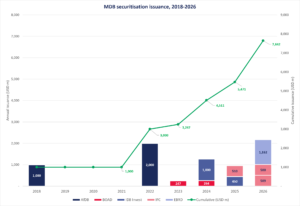
The use of securitisation by MDBs has increased significantly in recent years, becoming an increasingly important tool for mobilising private capital and making better use of balance sheets. A key milestone came in 2018, when the African Development Bank (AfDB) completed its $1 billion Room2Run transaction, the first portfolio synthetic securitisation between an MDB and private-sector investors. The transaction transferred a large share of the risk on around 50 private-sector loans and freed up capital for further lending. This was followed by the AfDB’s $2 billion Room2Run Sovereign transaction in 2022, and then by transactions from other MDBs, including IDB Invest’s $1 billion Scaling4Impact synthetic securitisation in 2024. Activity reached a new peak in 2026 with three securitisations (two from the International Finance Corporation (IFC) and one from the European Bank for Reconstruction and Development (EBRD)) totalling $2.2 billion.
In total, there have been 10 securitisation transactions (including the IDB Invest “retap” in 2025) from five MDBs, with a total issuance of over $7.6 billion. Significantly, seven of those transactions have come in the last three years, indicating an acceleration in their use. The transactions, including issuer and value, alongside cumulative issuance value are displayed in the graph below. The below chart (inspired by William Perraudin’s earlier work) shows the development of MDB securitisations since 2018.
Transparency in MDB securitisations is critical
Transparency in MDB securitisations is first and foremost a governance issue. In several of the MDB securitisations to date, significant public capital has been deployed to either derisk or mobilise private investors. The AfDB’s $1 billion Room2Run transaction used a European Commission guarantee to protect a senior-mezzanine tranche (a medium risk tranche of the investment structure), while the UK’s MOBILIST programme has invested public capital in IFC’s Emerging Markets Securitisation Programme (EMSP), pari passu (on an equal footing) with the IFC itself. When public balance sheets, guarantees or concessional capital are used to transfer risk to private investors, taxpayers, MDB shareholders and borrowing countries need to be able to see what risks are being transferred, on what terms, at what cost, and with what development additionality. Insufficient transparency makes it essentially impossible for independent observers to ascertain whether scarce public resources have been efficiently used and returned value for money. Even in instances where there is no public subsidy, a lack of transparency obscures whether the issuing MDB is appropriately pricing products.
Additionally, as with MDB investment activities, building markets through the creation of replicable and scalable products has been a central aspect of the narratives surrounding securitisations. IFC’s EMSP claims to be designed with these attributes at its core. Similarly, EBRD hailed its 2026 Mosaic securitisation as the “development of new MDB asset class”. At the same time, there have been important calls for improved coordination and learning between MDBs including through the 4th International Conference on Financing for Development (FFD4) Outcome Document. However, insufficient transparency creates the risk that replicability and scalability are limited to the originating institutions rather than the ecosystem as a whole.
Transparency of existing MDB securitisations
To date, the transparency of MDB securitisations has been uneven, marked by relatively high transparency concerning the structuring of transactions (such as providing outlines of tranches and participants in each tranche) but far lower transparency of the reference pool of loans in each transaction. The latter is typically limited to broad descriptions including the number of loans or lenders, and some information regarding sectors and geographies.
As noted by the Organisation for Economic Cooperation and Development (OECD), securitisations that list products on public markets are inherently more transparent. As such, investors and other stakeholders are able to identify additional information regarding IFC’s recent securitisations than was disclosed in relation to AfDB’s synthetic securitisation.
Acknowledging that more recent securitisations would not be expected to have contributed to additional lending to date, transparency regarding the development impact and additionality of existing securitisations is nonetheless low. For most transactions, it is not possible to tell whether the claimed additional headroom is being used. One notable exception to this can be seen with the AfDB Room2Run Sovereign transaction that has disclosed a number of climate related investments, in Kenya and Mauritius among other countries, that it states are directly attributable to the risk capital that was freed up by the securitisation and associated UK Government guarantee. Questions remain surrounding the true additionality of these projects, as being sure they would not have been funded regardless of the securitisation requires a counterfactual. It is not clear whether these are truly investments unlocked by the securitisation or whether they are investments that would have happened anyway and have the necessary attributes to be “badged” as qualifying under the securitisation’s climate finance focus.
The path forward
Securitisations seem to have become all the rage in development finance. In some senses they appear to be a magic bullet: boosting mobilisation figures, embedding the originate-to-share model that MDBs have been called upon to adopt, and potentially significantly increasing the lending capacity of institutions. However current levels of transparency mean that external stakeholders have to take many of the claims made on trust. Moreover, transparency deficits limit the replicability and scalability of the transactions.
At a minimum, MDBs should seek to develop standardised terminology and disclosure of fundamental aspects of securitisations. Currently, much information about existing securitisations has been parsed from a combination of press releases, investor prospectuses, and third-party ex-post analysis. Standardising these disclosures would improve institutional learning and contribute to the scalability and replicability of successful transactions. Where possible, there should also be efforts to disclose the underlying loans in securitisation reference pools. In instances where commercial confidentiality poses a legitimate and insurmountable barrier, this information could be anonymised or minimally aggregated.
Improving the transparency of MDB securitisations is not without industry precedent. Regulations set out by the European Securities and Markets Authority (ESMA) contain significant transparency requirements including loan level data. That such levels of transparency can be achieved in private sector transactions suggests it may be replicated in development finance. While it is clearly unlikely that MDBs will voluntarily adhere to similar regulations, it is incumbent on those who govern MDBs to press them to be more transparent about their use of securitisations. It is only then that stakeholders will be able to confidently ascertain that the potential of this form of innovative finance is indeed being met.