

News Roundup – Join the launch of the 2026 Aid Transparency Index and find out why Australia believes in aid transparency
Do trust and transparency still matter? Launch of the 2026 Aid Transparency Index
Wednesday 4 November 2026, 3 – 4.30pm GMT / 10 – 11.30am EST
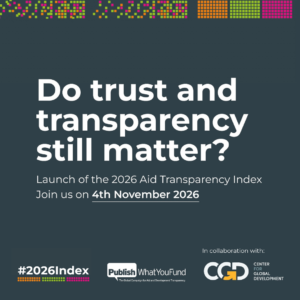 Join Publish What You Fund and the Center for Global Development to hear the headline findings and themes from the 2026 Aid Transparency Index, the leading global assessment of the transparency of major aid and development organisations, and take part in a timely discussion about the future of trust, transparency and evidence in development decision-making.
The 2026 Index comes at a critical moment. With development cooperation under pressure from rising global need, constrained aid budgets, geopolitical fragmentation, and increasing scrutiny of the effectiveness and legitimacy of international financing, does transparency still matter? What role does reliable, comparable and accessible data play in sustaining trust, supporting public confidence and enabling better decisions about where scarce resources should go? The discussion will consider what the changing politics of aid means for transparency—including the implications of shuttering USAID in 2025.
We’ll bring together perspectives from civil society, partner-country governments and development agencies to ask how transparency can strengthen coordination, accountability and learning; whether partner countries have the information they need ; and what we really know about where development resources are going and what they achieve.
We’re delighted to announce that Dr Sidi Ould Tah, President of the African Development Bank will deliver the keynote address at the launch event.
And we’re very pleased that Dr Tessie San Martin, CEO of FHI 360 and Chair of Friends of Publish What You Fund will be part of the panel. More speakers will be revealed shortly.
Why is Australia participating in the 2026 Aid Transparency Index?
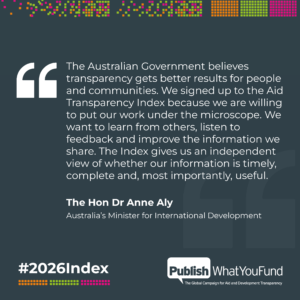 Australia’s Department of Foreign Affairs and Trade was one of the first agencies to sign up to participate in the 2026 Aid Transparency Index, reflecting the Australian Government’s renewed focus on transparency and accountability. While Australia’s 2024 Index result left significant scope for improvement, recent reforms demonstrate a clear shift in approach.
Ahead of its launch on 4th November, we asked the Hon Dr Anne Aly, Australia’s Minister for International Development, why Australia chose to take part in the Index and subject itself to scrutiny, and why it believes transparency is still important.
Read Dr Aly’s views on transparency
Sign up to be part of the 2028 Aid Transparency Index
We’re excited to announce that agencies not already part of the accreditation process can now sign up to access pre-Index benefits throughout 2027 and be part of the 2028 Aid Transparency Index. It’s a great opportunity to:
🔹 Demonstrate your leadership and commitment to transparency
🔹 Get an independent, credible transparency accreditation
🔹 Take advantage of expert guidance to improve your transparency
🔹 Promote your achievement
🔹 Benefit from peer learning and training
Find out more about the benefits and what’s involved in our information pack.
MDB securitisations: transparency must keep pace with financial innovation
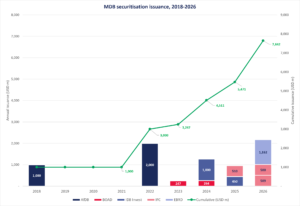 Multilateral development banks (MDBs) are increasingly turning to securitisation to free up capital and to mobilise private investors. It’s one response to the challenge of making their money go further. Since 2018, over $7.6 billion has been securitised by MDBs. As these transactions become more common, how much can we actually see and understand of what is going on?
In a new blog, Paul James unpicks what exactly securitisations are and why MDBs are using them. He explores whether underlying portfolios, costs, risks and development additionality are visible in existing transactions and how things could change in the future.
The blog argues that transparency needs to keep pace with financial innovation: transparency in MDB securitisation is critical for effective governance, for facilitating the replicability and scalability of transactions, and for ascertaining whether public resources are achieving the best value for money.
Other news
Here’s a quick roundup of other news and publications we’ve been reading over the last few weeks:
The Global Partnership for Effective Development Co-operation has launched Making Development Co-operation More Effective Progress Report 2026, alongside a new interactive Data Portal – which allows users to visualise the current findings and compare them across countries and over time. Co-published by the OECD and UNDP, the report draws on reporting from 44 partner country governments, 93 development partners, as well as civil society organisations, trade unions, and private sector representatives. Findings include:
- Development co-operation recorded on partner country budgets has fallen sharply — from 61% in 2018 to 41% in 2026 – limiting parliamentary oversight and national ownership.
- Progress on untying aid has stalled, medium-term predictability of funding has stagnated, and development partners’ use of country data and systems remains low and declining.
- Almost all partner countries now have a national development plan in place – most setting out clear priorities, targets and results indicators.
A new study by ODI Global, commissioned by rani, finds that EU development cooperation delivers for both partners and donors: where Europe invests in development in Africa, Europe sells more to those countries. Across twenty years of data covering 28 EU member states and 53 African partners, it finds that higher development assistance goes together with higher European exports. At average levels of aid and trade, each euro of EU institutions’ development assistance is associated with roughly €6.80 in additional European exports, around €5 in goods and around €1.80 in services.
A study from LMU published in Nature Communications compares the allocation of official development assistance (ODA) focused on global health with disease burden. Researchers from LMU Munich developed a machine learning pipeline using large language models to identify discrepancies in the allocation of health funding. The study classified 3.7 million development projects from 2000 to 2022 (US$ ~ 332 billion) using OECD data. The study finds that although funding and disease burden are significantly correlated for many diseases, there are notable disparities. For example, noncommunicable diseases NCDs account for 59.5% of global disease burden but received only 2.5% of health-related ODA over the study period. The results show aid–burden misalignment across multiple diseases in several regions, including Central Africa and parts of South Asia and West Africa.
CONCORD Europe has published Aid Watch 2026 which finds that between 2024 and 2025, EU ODA decreased by 11.4% in real terms, with historic cuts from both EU Member States and EU Institutions. The report found that in 2025, 22% of reported EU ODA was inflated, meaning that more than one in five euro counted as ODA did not reach Majority World countries, and the actual amounts of public resources available for poverty and inequalities reduction are lower than the official figures.
Center for Global Development has published a blog examining whether aid agencies are designing their programmes for success. The authors used AI models to review 244 official documents from 49 aid providers, assessing programme design processes across areas such as the use of evidence and cost-benefit modelling. Early findings suggest that multilateral providers generally have stronger programme design processes, though some bilateral donors, including Japan and the UK, also perform well.
A new Donor Tracker publication explores how rising humanitarian needs, shrinking ODA, and changing donor budget choices are reshaping the global humanitarian funding system. It considers how donors can make funding more flexible, transparent, and needs based while protecting humanitarian action without undermining essential development investments.
Transparency International has issued a new brief calling on the G20 to strengthen debt transparency, embed anti-corruption safeguards in lending frameworks, and improve domestic oversight of sovereign borrowing and debt management.
To coincide with the 40th anniversary of the Declaration on the Right to Development, Shabaka and ODI Global used the example of Sudan to try and trace how funding moves, from the moment a donor commits it to the moment a community uses it. The researchers found that even though
They had time, funding and institutional backing, they were unable to trace a single intermediated grant from end to end. They highlight that this lack of clarity around humanitarian funding is central to the wider challenge of realising the right to development. The researchers conclude that greater transparency is needed at every stage, alongside independent verification of where funds end up and reformed eligibility rules to allow local groups to access funding directly.
Ipas and Donor Tracker have explored how sexual and reproductive health and rights (SRHR) is being funded at a country level. The new brief examines domestic government spending, external finance, and private and innovative finance in Nigeria and Ethiopia.
OCHA Centre for Humanitarian Data has updated the design of the Humanitarian Data Exchange (HDX) platform to make data easier to find and understand.
Charities Aid Foundation (CAF) has published the 2026 World Giving Report: Donor Insights, which examines giving across 105 countries. It finds six in ten people donated in 2025, with giving closely linked to community belonging, trust, and understanding of local impact. Transparency was the leading factor donors said would encourage them to give more.
Sally Paxton of our sister organisation Friends of Publish What You Fund has talked to Devex about the US International Development Finance Corporation’s transparency gap, and why their lack of data matters.
Urgewald has released a report combining two assessments of the Asian Infrastructure Investment Bank’s (AIIB) transparency performance. It uses Publish What You Fund’s assessment from the 2025 DFI Transparency Index and findings from the AIIB Watch, a civil society initiative monitoring environmental and human rights risks in AIIB-financed infrastructure projects. It finds that transparency lacks implementation, and highlights persistent gaps between transparency commitments and what is actually disclosed at project level, so that information needed to assess environmental and social risks is often unavailable before approval.
A recent DevPolicy blog examines Australia’s aid transparency architecture, highlighting that substantially more information is now publicly available on Australia’s development programme. It says the next step in Australia’s transparency journey should be to publish two underlying datasets.
The OECD Development Statistics team is seeking views through its OECD Development Finance Statistics User Survey. It would like feedback from people who use OECD statistics on ODA and development finance to better understand how it is used and how new tools could make it easier to access, download and use.
Sign up to receive our newsletter direct to your inbox.