

How visible is development cooperation beyond the DAC?
As the traditional aid landscape shifts, a wider group of governments is playing a growing role in development cooperation. But how much of their contribution is visible in public data? The second report in our Making Impact Visible series assesses the transparency of 47 providers of international development cooperation that are not part of the OECD Development Assistance Committee (DAC). In this post, Henry Lewis sets out what the research covered, the strong data foundations it identified, and the information that’s missing.
Development cooperation is no longer organised around a small, stable group of traditional aid donors. A much wider set of governments now finance projects, share technical expertise, provide humanitarian assistance, offer scholarships and participate in triangular and regional cooperation. Many of these providers have decades of experience, and several are simultaneously recipients and providers. Their contribution is important, but the public data needed to understand their respective roles and impact remains uneven.
In light of the current, rapidly evolving aid landscape, transparency is a practical pre-condition that allows partner governments to plan and coordinate, legislatures and citizens to scrutinise public resources, civil society to follow implementation, and providers themselves to learn across portfolios. Without basic project and financial information, duplication is harder to detect, gaps are harder to fill and results claims are harder to test.
Non-DAC Providers, Transparency and the Global Data Landscape
The latest in our Making Impact Visible report series, Non-DAC Providers, Transparency and the Global Data Landscape, assesses 47 sovereign providers and their principal development cooperation institutions across six approaches to transparency. Forty-four are non-DAC providers;[1] Estonia and Latvia are DAC members, while Romania is a DAC Associate. These three were included in the research because their recent transition offers useful points of comparison.
Our research tested six channels:
- Detailed OECD Creditor Reporting System (CRS) data
- OECD estimates
- Actual 2024 Total Official Support for Sustainable Development (TOSSD) data
- Current International Aid Transparency Initiative (IATI) publication
- An official project portal
- A downloadable dataset.
Our research identified whether the agencies made data available through these channels, not the quality or accuracy of individual records.
Strong data foundation
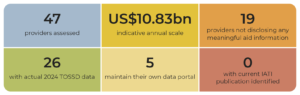
One positive finding is that many providers already participate in international reporting standards. Twenty-six providers have 2024 data in TOSSD, while detailed OECD CRS data is available for 16. These standards provide meaningful visibility and a foundation for further improvement. However, the assessment records CRS and TOSSD coverage primarily at provider-country level. The published data may span several government institutions and does not necessarily provide a complete, readily attributable picture of the portfolio managed by the primary agency.
A gap at project level
The largest gap is at the level where partner governments, civil society, researchers and affected communities can identify specific activities. Only five providers were found to operate an official portal containing at least a project name, partner country and cost, and only one offered a downloadable dataset. No current IATI publication was identified for any provider in the sample. This is especially significant because IATI is designed to provide timely, granular and structured project-level information.
Hidden scale
It is not just project-level information that is hard to find. Substantiated annual monetary figures were identified for only 32 providers, totalling approximately US$10.83 billion.[2] This should be treated as a conservative figure, not a comparable total, because the figures span different years and definitions, and figures for 15 providers could not be identified. Technical cooperation and other in-kind contributions are especially likely to be understated. The inability to produce a reliable total is itself a transparency weakness.[3]
Next steps: publish once, use often
Most providers already have the data and capacity to report internationally. The next step is publishing directly at project level, so partner governments, civil society and communities can see what is delivered, where, with whom and with what results.
The review makes five recommendations for providers:
- Build familiarity with IATI. Engage with the IATI Secretariat and its South–South Cooperation Working Group and consider piloting IATI publication for a selected portfolio. This would demonstrate its practical value while allowing providers to inform its continuing development.
- Strengthen international reporting. Where appropriate, move from estimates or aggregate figures towards detailed CRS and/or actual TOSSD activity data. Clearly identify the institutions and activities covered and use TOSSD’s provisions for recording financial and non-financial contributions.
- Develop an official project portal. Provide a searchable, agency-specific source covering projects, partners, dates, sectors, status and results. Include financial values where meaningful and non-financial quantities where these better represent the cooperation provided.
- Provide downloadable data. Support the portal with a regularly updated bulk download in a structured format such as CSV or JSON.
- Publish once, use often. Maintain a single authoritative project register that can supply the agency’s portal, IATI publication and international statistical returns. Clear responsibilities and quality checks would improve consistency and reduce duplication.
[1] Non-DAC providers are countries that provide international development cooperation but are not members of the OECD’s Development Assistance Committee (DAC), the forum of mostly high-income donors that sets the rules for defining and measuring official development assistance (ODA).
[2] Noting that US$7.5bn of this total relates to Türkiye.
[3] For each provider, the research sought the most defensible recent annual monetary figure available. Preference was given to official or internationally reported figures. Where these were unavailable, our calculations may use an allocation, an OECD estimate or a TOSSD cross-border amount. Multi-year announcements were not converted into annual spending without a clear timetable, and activities reported with zero or no monetary value were treated as unquantified rather than as zero cooperation.