

News roundup – 2026 Aid Transparency Index results and transparency beyond the DAC
Welcome to the latest roundup of news from the world of aid and development transparency.
The 2026 Aid Transparency Index results are out
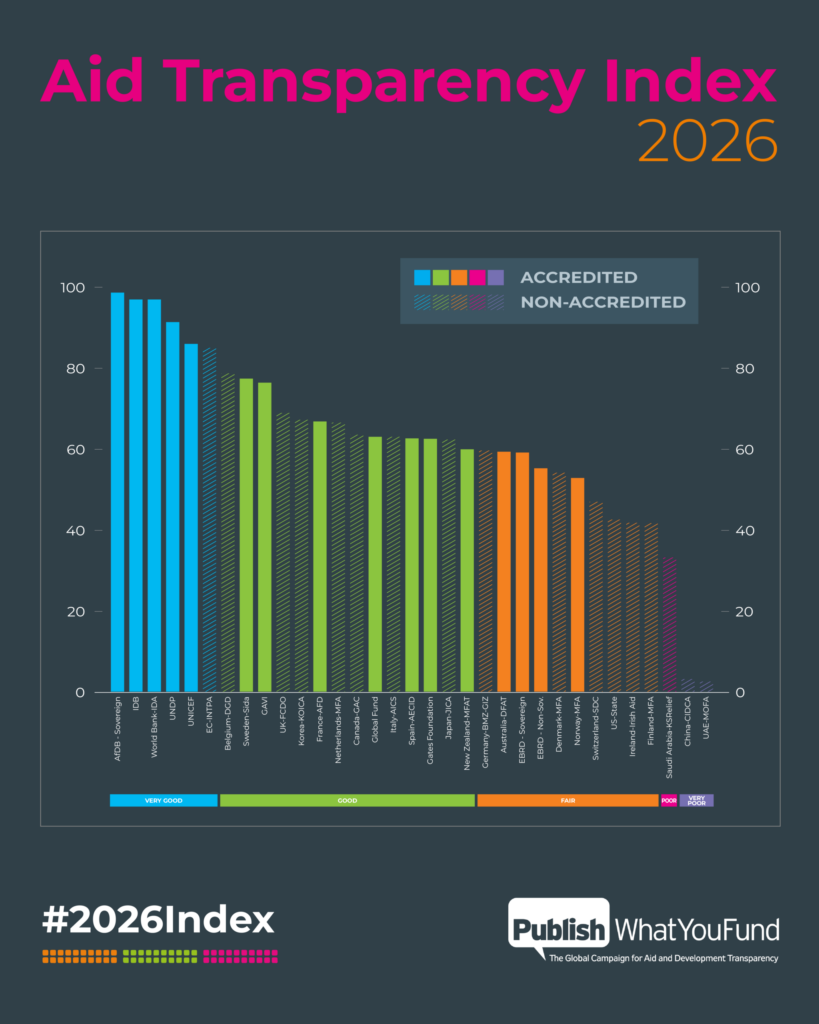
Despite the steepest fall in official development assistance on record, most of the world’s leading aid and development agencies are still publishing good quality information. Twenty of the 33 organisations we assessed in the 2026 Aid Transparency Index are rated “good” or “very good”.
The African Development Bank topped the Index for the third time running, with a score of 98.8. The Inter-American Development Bank and the World Bank’s International Development Association shared second place, followed by UNDP and UNICEF.
Spain’s AECID rose 57.7 points, the biggest improvement in the Index’s history. Australia’s DFAT gained 32.2 points, France’s AFD and Japan’s JICA also improved significantly, and Belgium’s DGD is now the top-performing bilateral agency.
But there’s more to do. The three largest aid providers – Germany, the US and the UK – all slipped, and the United Arab Emirates’ MOFA recorded the steepest fall, of 41.6 points. And results remain a black hole. Performance information is still the weakest area, averaging just 7.5 out of 20. In many cases the public can see what was spent, but not what it achieved.
See the full results and agency profiles
US transparency falls
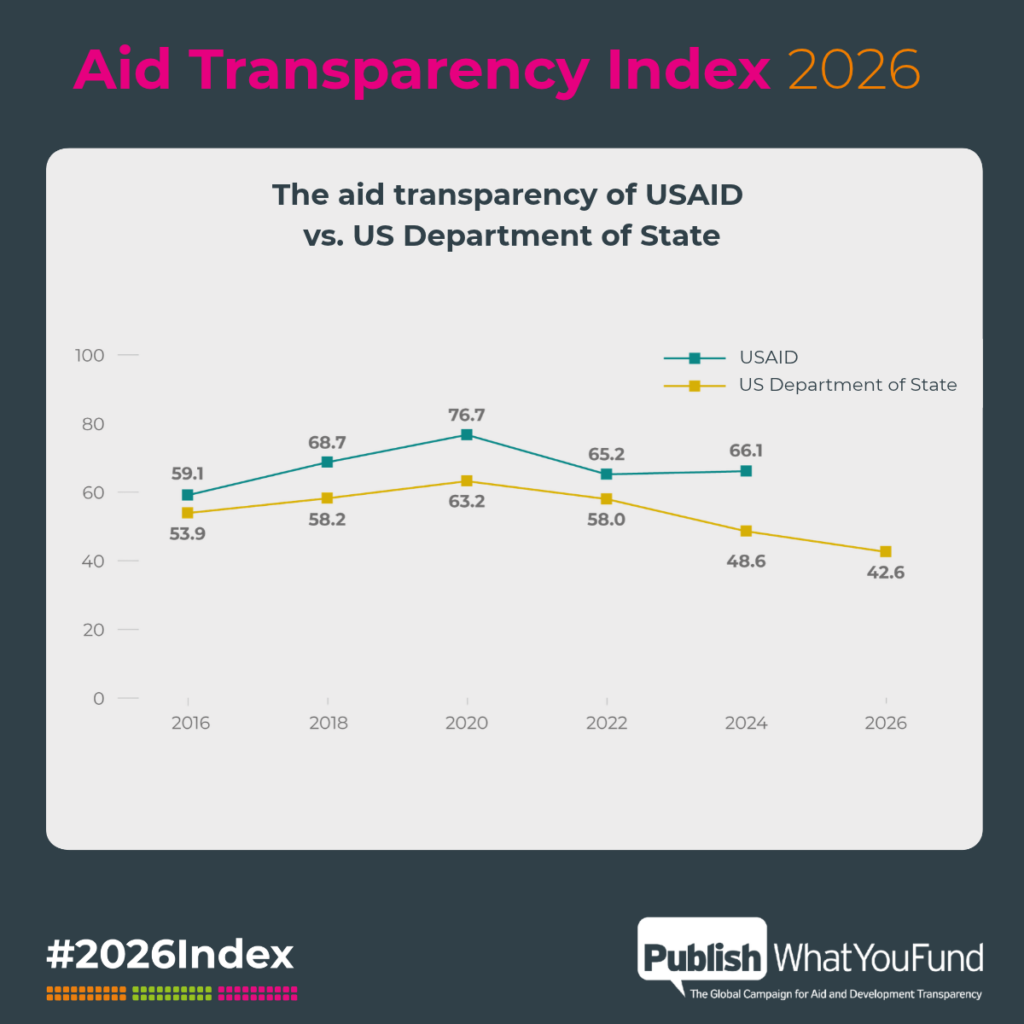
Since the US Agency for International Development (USAID) closed, the US Department of State has been the only US organisation in the Index. Its score fell from 48.6 to 42.6, which is 23.5 points below USAID’s 2024 score. The gaps in its data make it hard to connect US foreign assistance to plans, partners and results, just as the system is going through its biggest restructuring in decades.
Read all our analysis in the Index report
Watch the launch event: Do trust and transparency still matter?
Catch up on the launch of the 2026 Aid Transparency Index, hosted by Publish What You Fund and the Center for Global Development on 4 November 2026. Watch now to hear the headline findings and themes from the Index, and a discussion about the future of trust, transparency and evidence in development decision-making.
We were delighted to be joined by:
- Dr Sidi Ould Tah, President of the African Development Bank Group (keynote)
- Charlie Martial Ngounou, Founder and President, AfroLeadership
- Dr Tessie San Martin, former CEO of FHI 360 and Chair of Friends of Publish What You Fund
- Philippe Jahshan, Director of the Strategy, Foresight and Institutional Relationships Department, Agence Française de Développement (AFD)
- Ian Mitchell, Senior Fellow and Co-Director of the Europe programme, CGD (moderator)
- Gary Forster, CEO, Publish What You Fund (presentation of findings)
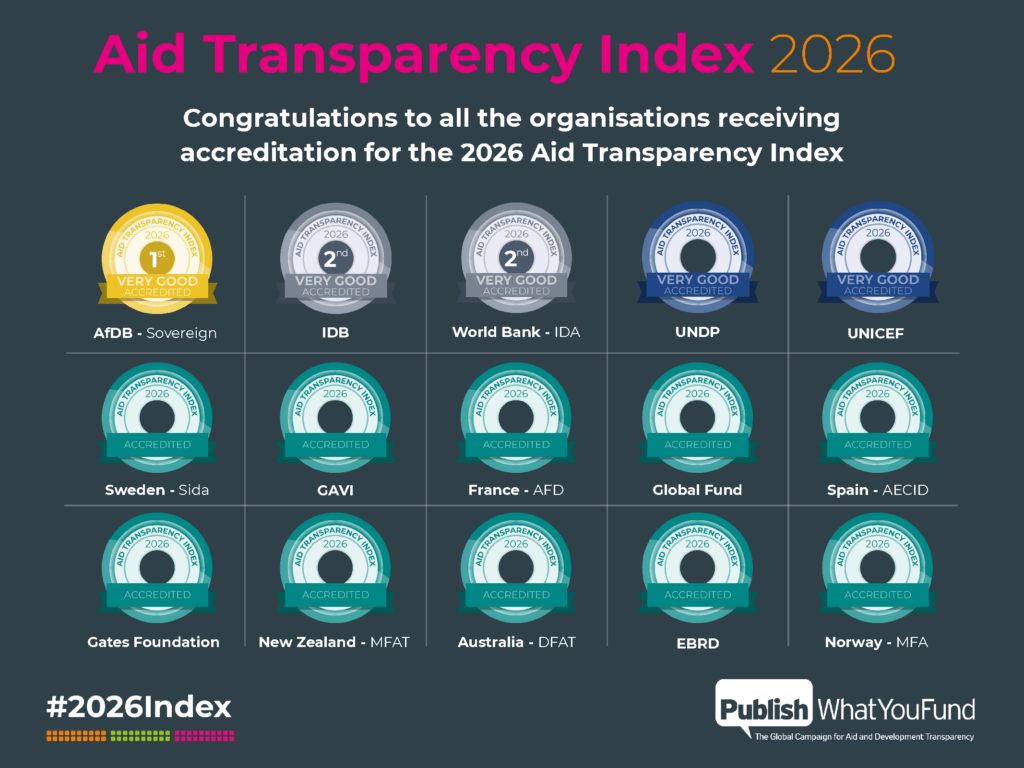
Congratulations to the 15 organisations accredited through the 2026 Aid Transparency Index
These organisations chose to open themselves to independent scrutiny, act on detailed feedback, and show their commitment to transparency.
France’s Agence Française de Développement (AFD) is one of the agencies that signed up to be part of the 2026 Index accreditation process. Ahead of the launch, we spoke to Catherine Bareyre, Head of Accountability and AFD Group Corporate Social Responsibility, about why AFD signed up and her experience of the Index accreditation process.
If your organisation would like to join them, you can now sign up for the 2028 Aid Transparency Index. You’ll get an independent assessment, expert feedback, training for your teams and peer learning, and you can earn the Accreditation Seal.
Find out more in our information pack
How visible is development cooperation beyond the DAC?
The Aid Transparency Index assesses 33 of the world’s leading aid and development finance organisations. However, the universe of organisations involved in delivering aid and development is far broader than those that can be included within the Index itself.
As the traditional aid landscape shifts, a wider group of governments is playing a growing role in development cooperation. The second report in our Making Impact Visible series assesses how much of their contribution is visible in public data, focusing on 47 providers that are not part of the OECD Development Assistance Committee (DAC).
The review found strong foundations to build on, with 26 providers publishing 2024 data in Total Official Support for Sustainable Development (TOSSD) and 16 reporting detailed data to the OECD Creditor Reporting System. But there was a gap in project information, with none of the providers publishing to the International Aid Transparency Initiative (IATI), the open standard designed for timely, project-level data and documents.
Transparency matters as it allows partner governments to plan and coordinate, legislatures and citizens to scrutinise public resources, civil society to follow implementation, and providers themselves to learn across portfolios.
Understanding the new MDB methodology on mobilisation – what’s changed and what are the implications?
The MDB Task Force on Mobilization has updated its guidance on how multilateral development banks measure private capital mobilisation (PCM). It’s the first update since 2018, so what are the implications?
In a new blog, Paul James considers exactly what changes the new Joint Methodology will introduce, and how it fits with the OECD approach and with Publish What You Fund’s proposals. He highlights:
📈 The new methodology broadens the scope of measurement to include portfolio level mobilisation, capital generated by the MDB’s risk rating, and eventually private capital catalysation.
💰 Despite stricter reporting rules, measuring new categories of mobilisation may push reported mobilisation figures up, raising the question of whether existing targets should be revisited so that progress reflects a change in business model rather than a change in how mobilisation is counted.
🔎 The new methodology says remarkably little about data transparency. Without granular, investment-level disclosure, it will be hard for stakeholders to understand why figures change, learn what works, scale it, or show other market participants where the opportunities lie.
Scale dominated the World Bank Annual Meetings – but where was the evidence of impact?
In FY2026, the World Bank mobilised $112 billion, three times the amount it managed four years ago. It was the headline of the Annual Meetings, and the achievement deserves recognition.
The focus of many discussions at the Annual Meetings was on how the World Bank and other multilateral development banks and development finance institutions could double down on these increases. In short, the message was that the World Bank needed to do more to crowd in private finance, and to do it faster. Indeed, the emphasis on scalability appeared contagious.
But one topic kept getting lost. What development impact did that capital achieve – either in terms of project results or market impacts? While mobilisation is increasingly viewed as the key to addressing development financing gaps, there is a risk that PCM begins to be treated as an end, rather than as a means of funding activities that will ultimately generate development impact.
The Publish What You Fund team that attended the Annual Meetings have reflected on their key takeaways in a new blog and look at how inadequate transparency is limiting the ability of stakeholders to address any concerns about the relationship between mobilisation and impact.
Other news
Here’s a quick roundup of other news and publications we’ve been reading over the last few weeks:
ONE Data has launched the Development Finance Observatory, which brings together data on development finance flows from the World Bank, IMF, OECD, UN and national governments in one place. It integrates data on aid, debt, climate and health finance, domestic budgets and remittances into a single open platform, with every number traceable to its source, and features an AI tool trained by development finance experts.
The Forest Tenure Funders Group has exceeded its $1.7 billion pledge to strengthen Indigenous and local communities’ rights to the tropical forests they have long stewarded. According to this Devex article, the coalition of five governments and 21 philanthropies delivered $2.35 billion over the past five years. However, the share reaching communities directly remains low. The share of funding transferred directly from donors to Indigenous-led institutions or funds, or to fiscal sponsors chosen by Indigenous peoples themselves, fell from 10.6% of that year’s pledge total in 2023 to 7.2% in 2025.
This Lowy Institute article looks at the impact of ODA cuts on Southeast Asia. Based on OECD preliminary data for 2025, it expects bilateral ODA for Southeast Asia from traditional donor countries to fall by at least a further $1.76 billion (19.6%). This is a smaller fall than the global decline of 23.3%. The Lowy Institute expects Vietnam, Timor-Leste and Thailand to be the most severely affected by the continued cuts. Asian donors, including Japan and South Korea, were previously expected to counterbalance Western aid cuts but are now also estimated to have reduced their development support in 2025. The authors argue that better information sharing and coordination among donors can reduce uncertainty and cushion the impact on recipient countries.
New CGD analysis finds that funding for evidence generation (funding evaluations, research programmes, and the institutions that produce them) is about to “fall off a cliff”. Spending was already low: evidence generation accounted for less than 1% of annual disbursements from 2010 to 2025. It is also concentrated: the UK’s FCDO and USAID were the largest funders of evidence generation. The authors call for other donors to step up and for better use to be made of the evidence that already exists.
The Kabul Institute has launched the Afghanistan Aid Tracker. Its accompanying report identifies $8 billion in confirmed humanitarian payments since August 2021 and reports that 91% could not be traced beyond the first recipient in the public data it examined.
Sign up to receive our newsletter direct to your inbox.