

2026 Aid Transparency Index: World’s three biggest aid donors fall back on transparency, while multilaterals lead the way
The 2026 Aid Transparency Index, released today by Publish What You Fund, shows that the three largest aid providers – Germany, the US and the UK – have become less transparent in the last two years. However, most of the world’s leading aid and development agencies are still publishing good-quality information, after the steepest fall in aid on record. Multilateral organisations lead the way, and Spain makes the biggest improvement in the Index’s history.
Official development assistance (ODA) fell by 23.1% in real terms in 2025[1], and further cuts are expected. With aid shrinking, timely data has never mattered more. Partner governments, civil society and affected communities need to know what has been cut, what funding remains, and who is now responsible for programmes that continue. Out-of-date information leaves them planning in the dark.
Countries need forward-looking data to plan effectively, but too often they don’t get it. In Nigeria, only 17% of development partners now share forward spending plans with the government, according to a recent OECD and UNDP report.[2] W 2025 Center for Global Development study found that missing data on the US HIV programme left partner countries unable to set realistic domestic HIV budgets, and other funders struggling to avoid gaps or duplication.[3]
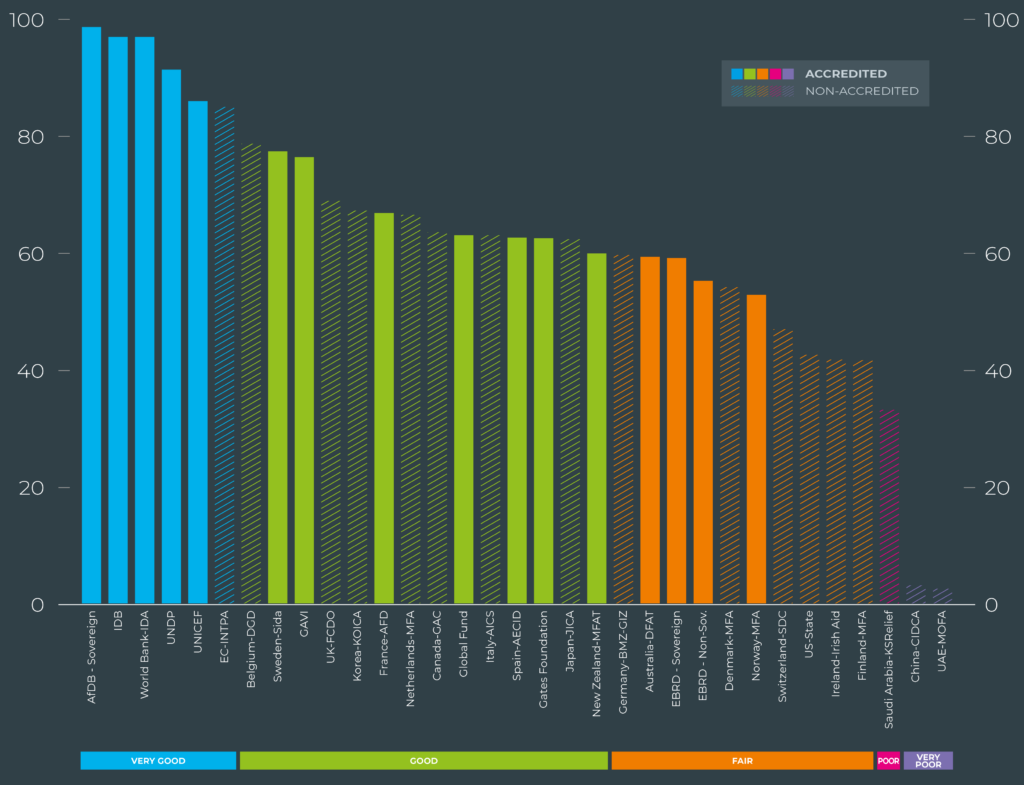
The 2026 Aid Transparency Index assesses 33 of the world’s leading aid and development organisations. Twenty of them (61%) are rated “good” or “very good”, and only three are rated “poor” or “very poor”. The average score held steady, at 62.1 compared with 62.7 in 2024.
Key findings
- Multilaterals set the standard. All five top places went to multilateral organisations. The African Development Bank came first for the third edition in a row, with 98.8 for its sovereign portfolio. The Inter-American Development Bank and the World Bank’s International Development Association shared second place with 97.1, followed by the United Nations Development Programme (UNDP) and the United Nations Children’s Fund (UNICEF).
- Spain and Australia surge. The Spanish Agency for International Development Cooperation (AECID) rose 57.7 points, from 5.0 to 62.7, the largest gain between editions in the Index’s history. Australia’s Department of Foreign Affairs and Trade (DFAT) gained 32.2 points. France’s Agence Française de Développement (AFD) and the Japan International Cooperation Agency (JICA) also improved significantly. Belgium’s Directorate-General for International Cooperation[4] is now the top-performing bilateral agency.
- The biggest donors slip. Together, Germany, the US and the UK gave over 40% of ODA in 2025, yet all three saw their transparency scores fall. Since the US Agency for International Development (USAID) closed, the US Department of State is the only US organisation in the Index. Its score fell from 48.6 to 42.6, which is 23.5 points below USAID’s 2024 score. Germany’s Federal Ministry for Economic Cooperation and Development (BMZ-GIZ) dropped 15.5 points. The UK’s Foreign, Commonwealth and Development Office (FCDO) lost 13.9 points. The United Arab Emirates’ Ministry of Foreign Affairs recorded the steepest fall, 41.6 points, after it stopped publishing data regularly.
- Results remain a black hole. Performance information is still the weakest area, averaging just 7.5 out of 20. In many cases the public can see what was spent, but not what it achieved.
- AI needs good data. AI tools are increasingly used to track and analyse aid. Tests for the report found that AI agents can now query raw aid data, check transactions, spot duplication and tell funders apart from intermediaries. But AI is only as good as the data it is fed. It cannot make up for missing, inaccurate or out-of-date information, and specialist judgement is still essential. As AI use grows, so does the value of complete, timely and well-structured data.
Gary Forster, CEO of Publish What You Fund, said:
“With less aid to go round, every dollar matters more. The multilateral organisations at the top of the Index, and the rapid progress of Spain and Australia, show what is possible when institutions commit to openness.
“Decisions about the future of aid are being made right now. Without public data, how can governments agree credible climate finance goals, or know whether emerging donors are filling the gaps? How can the aid system be redesigned, and how can cuts be made on evidence rather than guesswork? The world’s biggest donors must now match the standard set by the leaders, and publish what they fund and what it achieves.”
The 2026 Aid Transparency Index will be launched on 4 November in London and online, at an event hosted by the Center for Global Development, at 3pm GMT (10am in Washington DC). The event will feature a keynote address from Dr Sidi Ould Tah, President of the African Development Bank Group, which tops the Index for the third time running. Register here.
The full results and agency profiles are available here.
Notes:
[1] The ODA figures are preliminary 2025 data from the Organisation for Economic Co-operation and Development (OECD).
[2] OECD and UNDP (2026), Making Development Co-operation More Effective: 2026 Progress Report, Global Partnership for Effective Development Co-operation, OECD Publishing, Paris. Nigeria findings as reported in ThisDay, 21 September 2026. https://www.oecd.org/en/publications/2026/09/making-development-co-operation-more-effective-progress-report-2026_b7ac6c78/full-report/making-development-co-operation-funding-predictable-and-gender-responsive_788b87ee.html
[3] Godbole, R. (2025), “PEPFAR’s Missing Data: Why Transparency Matters More Than Ever”, Center for Global Development, 20 October 2025. https://www.cgdev.org/publication/pepfars-missing-data-why-transparency-matters-more-ever
[4] At the time of the Index assessment, Belgium’s Directorate-General International Cooperation (DG INT) was known as Directorate-General for Development Cooperation and Humanitarian Aid (DGD).