

Donors promise new partnerships; their data says otherwise
Donors have never talked more about new partnership and country ownership. Yet the 2026 Aid Transparency Index, which we launched at the start of the month, shows the world’s biggest donors are already publishing less of the one thing partnership depends on: their plans. That gap matters more after the steepest fall in aid on record, and AI is about to make it impossible to hide.
The biggest donors are slipping
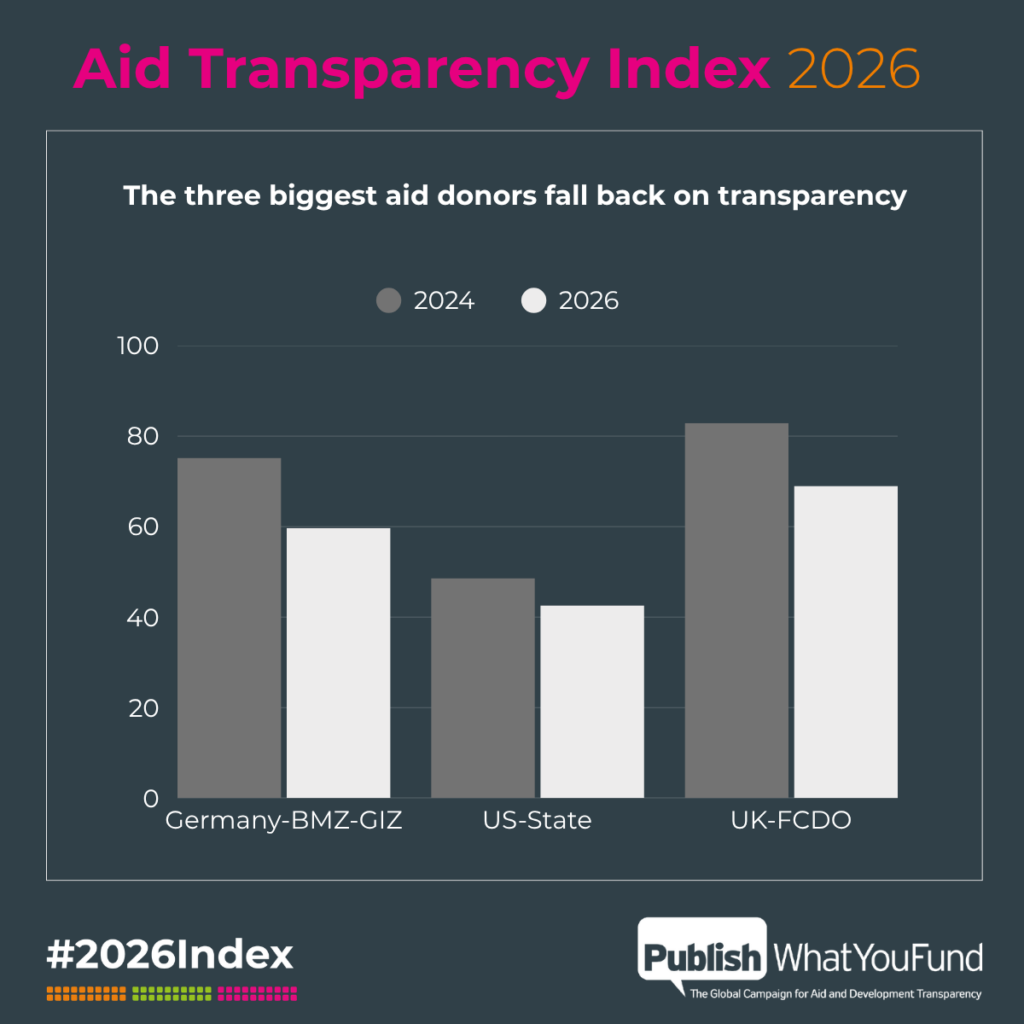
Germany, the US and the UK provided over 40% of official development assistance (ODA) in 2025. All three became less transparent in the last two years. Germany’s BMZ-GIZ fell 15.5 points and the UK’s FCDO 13.9. The State Department, now the only US agency in the Index, scored 23.5 points below USAID’s 2024 score.
The wider picture is more encouraging. Twenty of the 33 organisations ranked are “good” or “very good”, multilaterals took the top five places, and Spain’s AECID rose 57.7 points, the biggest gain in the Index’s history. Transparency can be rebuilt fast when leaders decide it matters.
But look at where data is missing from the big three. The gaps are concentrated in forward-looking budgets, strategies and objectives: the documents that tell partners what a donor plans to do. The UK’s FCDO does not publish comprehensive forward-looking budgets for the countries where it works, or full country and organisational strategies. Germany has published less financial and forward-looking information. For the State Department, we found no published policy explaining how it decides where aid goes, no annual report, no breakdown of its budget, and its project data leaves out budgets and objectives. We can still see much of what these donors spent. We are losing sight of what they plan to do next.
It would be easy to shrug at this: when budgets are cut, of course plans go out the window. But cuts do not stop a donor knowing what it now intends to spend. Publishing a plan is not a promise that it will never change; it is actually a commitment to tell partners what you intend to do now and to update them when that shifts. In such situations a country strategy, a policy on how aid is allocated or a project’s objectives help make partnership real.
Partnership without a plan
That is where rhetoric and reality part company. The UK describes its new approach as “partnership not paternalism”. The US has signed dozens of new bilateral health agreements asking partner governments to take on more of the cost. Yet, as the Center for Global Development has noted, little is public about how those agreements were designed. These are recent commitments, and the transparency they depend on is already going backwards.
Ownership means a finance ministry can put your money in its budget, a parliament can scrutinise it and a health ministry can plan to take over costs as you step back. None of that works without forward-looking information. The OECD and UNDP’s 2026 progress report found that only about half of development partners share forward spending plans with governments, no better than in 2018. The share of aid recorded on partner country budgets fell from 61% to 41% over the same period.
At our launch event with CGD, Charlie Martial Ngounou of AfroLeadership described the cost. Partner countries cannot influence donors’ domestic politics, he said, so they at least need to see decisions coming in time to adapt. The worst damage from recent cuts came from abrupt exits in the middle of a budget year.
You cannot ask a government to co-finance, take over or plan around you while withholding what you intend to spend, where and when. Without the plan, “ownership” just means absorbing the shock.
AI will expose the gaps
We’ve tested whether AI agents could analyse raw aid data published to the International Aid Transparency Initiative, or IATI. Between June and September, the agent went from retrieving data to behaving like an analyst, tracing food aid to Ethiopia across 229 transactions and spotting duplicate reporting.
Soon a budget officer or a local journalist will be able to use AI to ask which donors have published three-year plans for their country, and get an answer in minutes. Indeed a number of partner governments are already using it: according to the International Aid Transparency Initiative, 23 now bring IATI data into their public financial management systems, and as an example, Nigeria’s dashboard tracks aid against its own national development plan.
The risk cuts the other way too. AI cannot make up for missing or out-of-date information; given gaps, it fills them with confident guesses. As Tessie San Martin, chair of Friends of Publish What You Fund, put it at the launch: garbage in, garbage out.
What donors should do
If donors mean what they say about partnership, they should publish the plan. That starts with forward-looking budgets, set out country by country and at least three years ahead, so a finance ministry can put aid on its own budget and see in advance when support will end. Any compact that asks a government to take on costs should be published with its financing schedule.
Budgets also need the strategies and objectives that explain them. A government cannot align with a donor whose country strategy is unpublished, or whose projects do not say what they are meant to achieve. This is not a hard ask: 28 of the 33 organisations in the Index publish objectives for at least some of their projects, and 11 do so for almost all of them.
With less aid, every dollar matters more, and so does every plan. If donors want to be treated as partners, they need to publish not just what they fund, but what they plan to fund.